Superscript and Subscript Letters: The Full Unicode List
Every superscript and subscript letter and digit in Unicode, which blocks they live in, and the exact letters that do not exist in either alphabet.
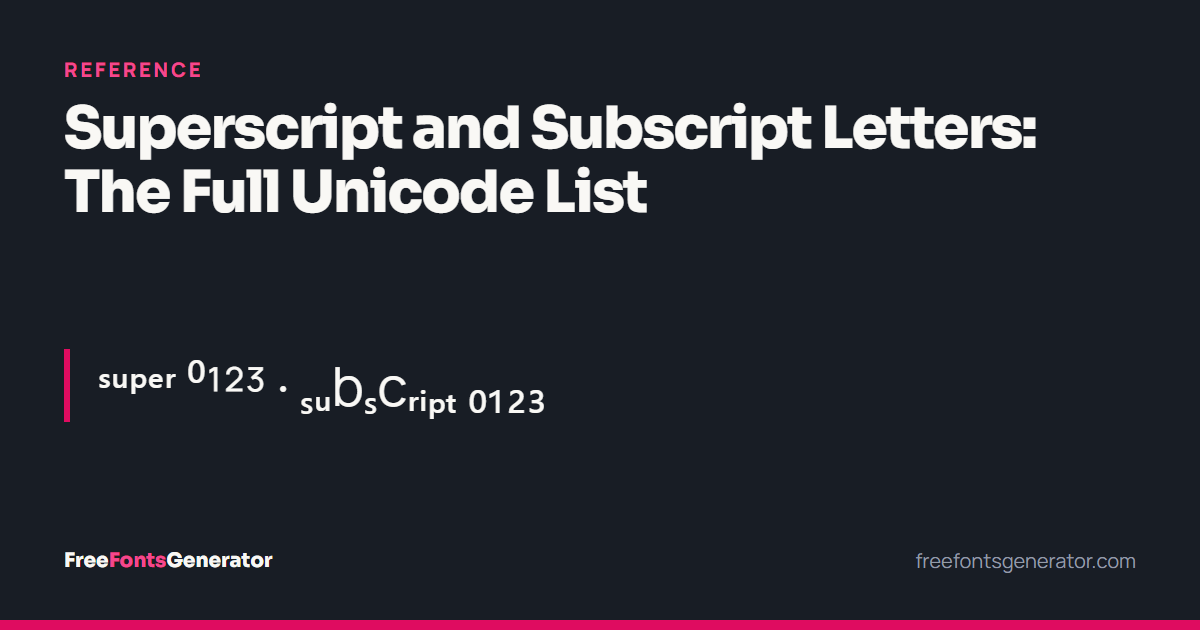
Superscript and subscript in real typography are positioning: the same letter, raised or lowered and scaled down by the renderer. <sup> in HTML, font-variant-position in CSS.
In Unicode they are separate characters, and the sets are incomplete. Neither alphabet has all 26 letters, and the subscript one has barely half. Everything on this page follows from that.
Superscript digits
Complete, all ten, and the most reliably supported characters here.
| Digit | Superscript | Code point |
|---|---|---|
| 0 | ⁰ | U+2070 |
| 1 | ¹ | U+00B9 |
| 2 | ² | U+00B2 |
| 3 | ³ | U+00B3 |
| 4 | ⁴ | U+2074 |
| 5 | ⁵ | U+2075 |
| 6 | ⁶ | U+2076 |
| 7 | ⁷ | U+2077 |
| 8 | ⁸ | U+2078 |
| 9 | ⁹ | U+2079 |
Note the oddity: 1, 2 and 3 are in Latin-1 Supplement, not with the others. They came from ISO 8859-1, which had them for ordinals and units — m², m³ — and Unicode inherited them at their old positions. The rest are in Superscripts and Subscripts at U+2070–U+209F.
Also there: superscript ⁺ ⁻ ⁼ ⁽ ⁾ ⁿ, which is enough to write a simple exponent in plain text.
Superscript letters
| Case | Available |
|---|---|
| Capitals | ᴬ ᴮ ᶜ ᴰ ᴱ ᶠ ᴳ ᴴ ᴵ ᴶ ᴷ ᴸ ᴹ ᴺ ᴼ ᴾ ᴿ ᵀ ᵁ ⱽ ᵂ |
| Missing capitals | Q, S, X, Y, Z |
| Lowercase | ᵃ ᵇ ᶜ ᵈ ᵉ ᶠ ᵍ ʰ ⁱ ʲ ᵏ ˡ ᵐ ⁿ ᵒ ᵖ ʳ ˢ ᵗ ᵘ ᵛ ʷ ˣ ʸ ᶻ |
| Missing lowercase | q |
So a superscript conversion of “Squeeze” comes back as Sqᵘᵉᵉᶻᵉ — the capital S and the q survive unchanged, because there is nothing to convert them to.
The characters are spread over three blocks. Lowercase letters are mostly in Spacing Modifier Letters, U+02B0–U+02FF, where they were encoded as phonetic modifiers — ʰ marks aspiration, ʷ labialisation. Capitals and the remaining lowercase are in Phonetic Extensions at U+1D2C onwards, added for Uralic transcription. A few strays sit elsewhere, such as ⱽ at U+2C7D in Latin Extended-D.
Again: nobody encoded a superscript alphabet. These are phonetic symbols that happen to be raised, and the gaps are the letters no transcription system needed.
Subscript letters and digits
The digits are complete. The letters are not close.
| Digit | Subscript | Code point |
|---|---|---|
| 0–9 | ₀ ₁ ₂ ₃ ₄ ₅ ₆ ₇ ₈ ₉ | U+2080–U+2089 |
Plus ₊ ₋ ₌ ₍ ₎ for simple formulae.
| Case | Available |
|---|---|
| Capitals | none at all |
| Lowercase | ₐ ₑ ₕ ᵢ ⱼ ₖ ₗ ₘ ₙ ₒ ₚ ᵣ ₛ ₜ ᵤ ᵥ ₓ |
| Missing lowercase | b, c, d, f, g, q, w, y, z |
Seventeen letters out of twenty-six, and no capitals whatsoever. Converting “Discord” to subscript gives Dᵢₛcₒᵣd — four letters converted, three untouched, one capital untouched.
Why so few? The subscript letters were encoded for chemical and mathematical notation, where subscripts are mostly digits and a small set of index variables — i, j, k, n, x. Nobody needed a subscript q, so there is not one.
What this means for a generator
Any tool offering “tiny text” or “small text” is working with these sets, and there are only three honest options for a missing letter:
- Leave it unchanged.
Sqᵘᵉᵉᶻᵉ. Honest, visibly inconsistent. This is what our small text generator does. - Substitute a lookalike from another block. Fills the hole, produces characters of the wrong size and wrong weight, and often worse font support.
- Fall back to small capitals for the missing letters, mixing two alphabets.
There is no fourth option where all 26 letters exist, because they do not exist. A generator claiming a complete superscript alphabet is doing option 2 without telling you.
What they are actually for
Ordinals, units and footnote markers
Ordinals and units. 1ˢᵗ, m², km³, 20°C — in plain-text contexts where no markup is available.
Chemistry and maths in plain text. H₂O, CO₂, xᵢ, aⁿ. Imperfect but readable, and far better than H2O in a field that cannot do markup.
Footnote markers. See the note¹ works in a bio, a caption or a plain-text email.
Superscript letters to copy and paste, for a bio
Decoration. Small text in a username or bio, which is what most people arrive looking for.
Font support and accessibility
Digits are safe. The superscript and subscript digits are old, widely covered, and render essentially everywhere.
Letters are patchier. The Phonetic Extensions characters are less commonly covered than the Latin-1 ones, and some fonts substitute from a fallback face, so a superscript word can come out with letters at visibly different weights even when they all render.
Screen readers and normalisation
Screen readers are inconsistent. Some map these back to letters, some read the phonetic names. As with small caps, it is not reliable enough to depend on.
Most have compatibility decompositions. ² decomposes to 2, ᵃ to a. So NFKC folds superscript and subscript text back to plain — H₂O becomes H2O, which is usually what a search index wants and occasionally a surprise.
Use the real thing where you can
If you control the markup, use it:
E = mc<sup>2</sup>
H<sub>2</sub>O
The result is correctly positioned and scaled by the font, works for every letter including the missing ones, reads correctly in a screen reader, and is searchable. Unicode superscripts are for plain-text fields where no markup exists — a bio, a username, a chat message.
Quick answers
Is there a superscript Q?
No capital Q and no lowercase q. Neither exists in Unicode.
Are there subscript capital letters?
None at all.
Why do some letters stay full size?
Because Unicode has no superscript or subscript form of them. Nothing can be converted to a character that does not exist.
Why are ¹ ² ³ in a different block?
They came from ISO 8859-1 and Unicode kept them at their inherited positions.
Do they survive normalisation?
No. NFKC converts them back to plain characters.
Related
- Small text generator — superscript and small caps applied to your text
- Small caps in Unicode — the other small alphabet
- Unicode normalisation — why NFKC folds these away
- Unicode blocks reference — every block used here