Small Caps in Unicode: Where the Letters Come From
Small caps Unicode reference: the phonetic blocks the small capital letters live in, the full alphabet, the letters that do not exist, and why X is missing.
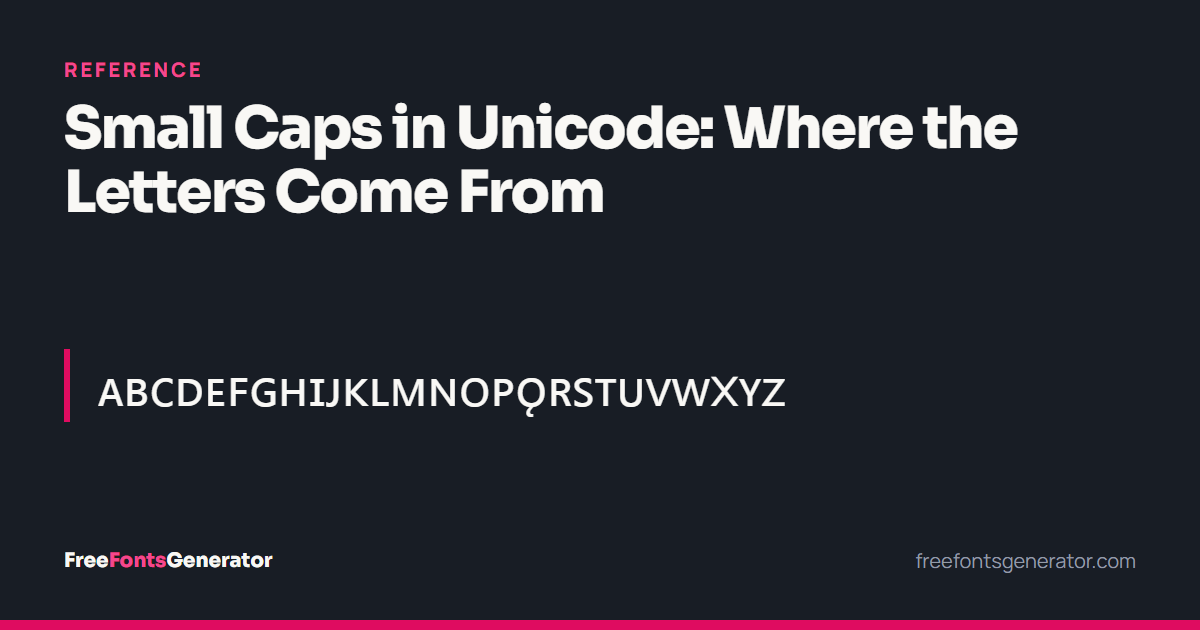
Small capitals in real typography are a font feature: a typeface designer draws a second set of capital letterforms at roughly lowercase height, with weights adjusted so they do not look spindly beside the full capitals. In CSS you turn them on with font-variant-caps: small-caps, and the font does the work.
The small caps on this site are something else entirely. They are individual Unicode characters, borrowed from blocks that were encoded for phonetics, and the difference explains every limitation below.
The alphabet
| Letter | Small cap | Code point | Block |
|---|---|---|---|
| A | ᴀ | U+1D00 | Phonetic Extensions |
| B | ʙ | U+0299 | IPA Extensions |
| C | ᴄ | U+1D04 | Phonetic Extensions |
| D | ᴅ | U+1D05 | Phonetic Extensions |
| E | ᴇ | U+1D07 | Phonetic Extensions |
| F | ꜰ | U+A730 | Latin Extended-D |
| G | ɢ | U+0262 | IPA Extensions |
| H | ʜ | U+029C | IPA Extensions |
| I | ɪ | U+026A | IPA Extensions |
| J | ᴊ | U+1D0A | Phonetic Extensions |
| K | ᴋ | U+1D0B | Phonetic Extensions |
| L | ʟ | U+029F | IPA Extensions |
| M | ᴍ | U+1D0D | Phonetic Extensions |
| N | ɴ | U+0274 | IPA Extensions |
| O | ᴏ | U+1D0F | Phonetic Extensions |
| P | ᴘ | U+1D18 | Phonetic Extensions |
| Q | ǫ | U+01EB | Latin Extended-B |
| R | ʀ | U+0280 | IPA Extensions |
| S | ꜱ | U+A731 | Latin Extended-D |
| T | ᴛ | U+1D1B | Phonetic Extensions |
| U | ᴜ | U+1D1C | Phonetic Extensions |
| V | ᴠ | U+1D20 | Phonetic Extensions |
| W | ᴡ | U+1D21 | Phonetic Extensions |
| X | x | — | does not exist |
| Y | ʏ | U+028F | IPA Extensions |
| Z | ᴢ | U+1D22 | Phonetic Extensions |
Five different blocks for one alphabet, and one letter missing. That is not an oversight in the converter — it is what Unicode contains.
Why it is scattered across five blocks
Because nobody ever set out to encode a small-caps alphabet. Each of these characters was added for its own reason, mostly phonetic.
The International Phonetic Alphabet uses small capitals as distinct symbols: ɢ is a voiced uvular plosive, ɴ a uvular nasal, ʀ a uvular trill. They are not stylistic variants of G, N and R — they are different sounds, and they needed code points. That accounts for IPA Extensions at U+0250–U+02AF.
Phonetic Extensions, U+1D00–U+1D7F, was added later for the Uralic Phonetic Alphabet and other transcription systems, which needed more small capitals than the IPA used. That is where most of the alphabet comes from.
Latin Extended-D supplied ꜰ and ꜱ for medieval manuscript transcription. And ǫ at U+01EB is not a small capital at all — it is a lowercase o with ogonek, a Polish and Old Norse letter, pressed into service because it is the closest available shape. Most converters use it, including ours; a few use Q unchanged instead.
The missing X
There is no small capital X in Unicode. Any small-caps text you see keeps a plain lowercase x, which is why ʀᴏʙʟᴏx has one letter that sits slightly wrong.
The reason is the same as everything else here: no phonetic system needed one. Small capital X does not represent a distinct sound in the IPA or in Uralic transcription, so it was never proposed, and Unicode does not add characters for stylistic completeness. A proposal would have to argue it encodes something.
Real small-caps fonts have no such problem: they draw an X because they draw every letter.
No capitals, no digits
Two more consequences of the borrowed origin.
There is no uppercase. Small capitals are the letterforms; there is no second set. Converters map both A and a to ᴀ, which means text run through them comes back with its capitalisation flattened — ʀᴏʙʟᴏx gives no sign that the R was a capital.
There are no digits. No small-cap 0–9 exists, so numbers pass through unchanged: ᴀᴘᴀʀᴛᴍᴇɴᴛ 12ʙ. Same for punctuation.
What they are good for
Despite the gaps, small caps are one of the more practical styles on this site, for two reasons.
Small caps render where bold Unicode does not
They render almost everywhere. All these characters are in the Basic Multilingual Plane and have been in fonts for a long time, so they show up on old devices where the mathematical alphabets turn into empty boxes. If you need styled text that will not break on an old Android phone, small caps and fullwidth are the safest choices.
They read as quiet rather than loud. Bold and script styles shout. Small caps look considered, which suits a bio line, a username or a section heading.
The small text generator covers them alongside the superscript alphabet, and the font generator shows them with everything else.
What they cost
Screen readers vary wildly. Some map these characters back to letters and read the word; others read the phonetic names, so ʜᴇʟʟᴏ becomes “latin letter small capital H, latin letter small capital E”. It is not consistent enough to rely on.
Search does not match them. ʜᴇʟʟᴏ is not hello in any search box.
Why NFKC leaves small caps alone
NFKC does not fix it. Unlike the mathematical alphabets and fullwidth text, most of these characters have no compatibility decomposition — because they are not stylistic variants of Latin letters, they are phonetic symbols in their own right. So NFKC leaves them alone.
That has a consequence worth knowing: small caps survive normalisation on platforms where bold and fullwidth text is folded back to plain. It also means a system that is trying to normalise lookalikes to prevent impersonation will not catch them, which is one reason some platforms filter these characters explicitly.
Real small caps, when you can use them
If you control the typography — a website, a document, a design — do not use these characters. Use the font feature:
.brand { font-variant-caps: small-caps; }
The result is better on every axis: correct letterforms including X, correct weight, capitalisation preserved, searchable text, and a screen reader reads it as the word it is. The Unicode characters are for the places where no styling is possible at all.
Quick answers
Why is there no small capital X?
No phonetic alphabet needed one, so it was never encoded. Unicode does not add characters purely for stylistic completeness.
Why is the Q shape odd?
Most converters substitute ǫ, an o with ogonek, because no small capital Q exists.
Do small caps keep my capital letters?
No. There is only one case, so capitalisation is lost.
Will small caps work in a username?
Often, and more reliably than the mathematical alphabets — though some platforms filter non-Latin characters in names.
Are they better supported than bold Unicode?
Yes. They are in the Basic Multilingual Plane and covered by older fonts.
Related
- Small text generator — small caps and superscript applied to your text
- Superscript and subscript — the other “small” alphabet, with bigger gaps
- Unicode blocks reference — every block used here
- Unicode normalisation — why these survive NFKC