What Is Zalgo Text? The Unicode Behind the Glitch Effect
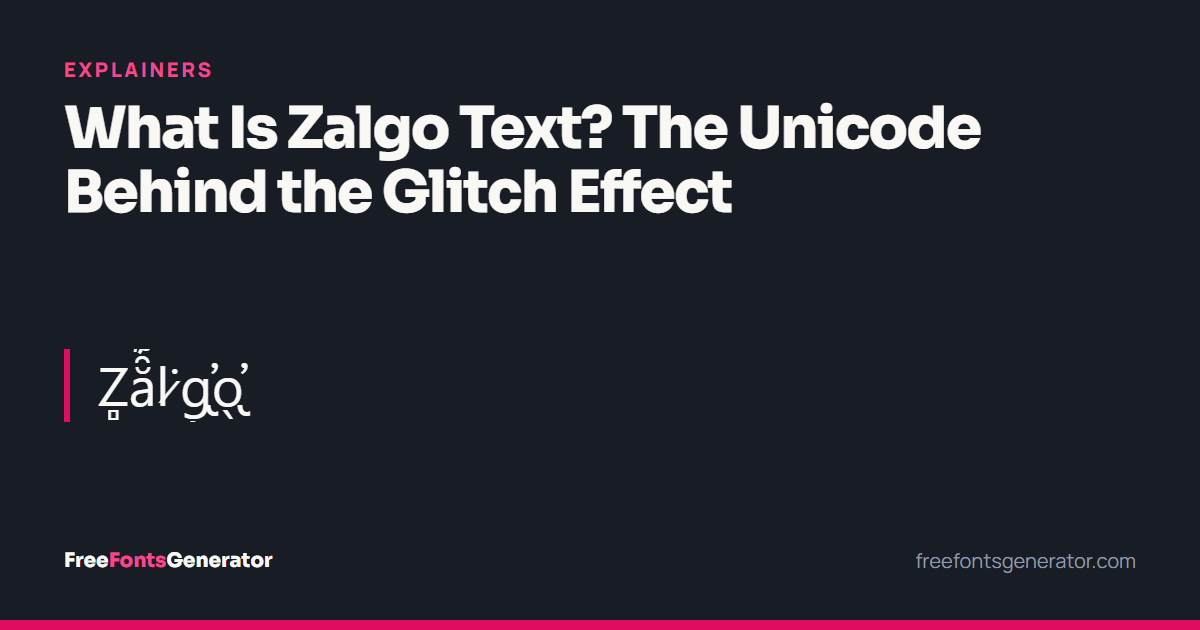
Zalgo text is the writing that appears to be falling apart — letters with marks spilling above and below them, overflowing into the lines around it. It looks like corrupted data. It is not. It is completely valid Unicode, doing exactly what the standard says it should, taken to an extreme nobody designing the standard had in mind.
What Zalgo text actually is
Unicode has two kinds of character that matter here. A base character is a letter like a. A combining mark is a character with no width of its own that attaches to whatever came before it — an accent, a cedilla, a dot.
So e followed by U+0301 COMBINING ACUTE ACCENT renders as é. One base character, one mark, one visible glyph. This is ordinary, it is how a great deal of the world’s text is written, and it is specified in Chapter 2 of the Unicode Standard.
The standard does not say how many marks you may attach. So:
e+ one mark → ée+ five marks → e̛̗̣͐͊̽e+ thirty marks → a vertical smear reaching several lines up and down
That is Zalgo. There is no special character, no hidden encoding and no trick. It is one base letter with a large number of ordinary combining marks stacked on it, and the renderer dutifully drawing every one.
The marks come from several blocks: Combining Diacritical Marks at U+0300–U+036F is the main one, with Combining Diacritical Marks Supplement, Extended, and For Symbols supplying the rest. Generators typically split them into three groups — marks that sit above, marks that sit below, and marks that strike through the middle — and let you dial each independently, which is how you get an effect that leans upward or downward.
Our Zalgo glitch text generator exposes those three dials, and the reference on combining diacritical marks lists the blocks themselves.
Where Zalgo text came from
The name comes from an internet horror figure that surfaced on the Something Awful forums around 2004, associated with copypasta about a creature whose arrival corrupts the text describing it. “He comes” is the line most people remember. The visual effect — text disintegrating as you read it — was the joke, and the technique to produce it spread far past the original meme.
What is interesting is that nobody invented the technique. Stacked combining marks had always been possible; the meme just noticed. Wikipedia’s article on Zalgo text has the trail.
Why it overflows its line
A combining mark is drawn relative to its base character, not inside a box the layout engine reserved. When you stack thirty of them, the drawing extends far outside the line’s normal height — and in most layout engines, nothing clips it.
That is why Zalgo appears to invade the text above and below it. In a web page the effect is cosmetic. In an application that measures text to decide how tall a row should be, it can genuinely break a layout, which is why some software strips or limits combining marks defensively.
The Unicode Standard anticipated this, sort of. Unicode Standard Annex #15 defines a Stream-Safe Text Format that caps a sequence at 30 combining marks in a row, precisely so implementations can size their buffers. It is a recommendation for processing, not a rule that text must obey, and nothing stops a generator from producing more.
Why Zalgo sometimes disappears
Paste Zalgo into different places and you get four different outcomes, depending on what the software does.
Four things software does with it
It renders fully. Browsers, Discord, most desktop apps. The marks stack as drawn.
It renders clipped. Some mobile apps clamp line height, so the marks are drawn but cut off at the row boundary. You get a letter with a hard-edged smudge.
It gets stripped. Platforms that sanitise input — many usernames, many search fields, most e-commerce forms — remove combining marks or reject the string. This is deliberate, and often a security measure.
It gets normalised. Some systems apply Unicode normalisation to incoming text. Worth understanding what this does and does not do: NFC will combine a base and a mark into a single precomposed character where one exists — e + acute becomes é, one character. But there is no precomposed character for e with twenty-nine marks, so the rest stay exactly where they were. Normalisation tidies Zalgo slightly and does not remove it. The reference on Unicode normalisation covers the forms.
What Zalgo text breaks
Worth knowing before you put it anywhere that matters.
The accessibility cost of glitch text
Screen readers. This is the serious one. Assistive software reading a Zalgo string may announce every single combining mark by name — “combining acute accent, combining grave accent, combining tilde below” — for every letter. A short Zalgo word can take a minute to read aloud. It is not decoration to a screen reader user; it is an obstruction.
Search. Z̻͖ă̑͊l̷͂͘g̢̖̕o̢̖̕ is not the word “Zalgo” to any search index. The base letters are in there, but they are separated by dozens of marks, and most matching will fail.
Why a five-letter Zalgo word is 300 characters
Character limits. Every mark is a character. A Zalgo word that looks like five letters can be three hundred characters long, which blows past a bio limit or a message cap instantly. The character counter will show you the real count.
Copy and paste. It survives copy and paste perfectly, which is the point — but it also survives into places you did not intend, like a spreadsheet cell or a database field, where it can be surprisingly hard to clean out afterwards.
Using it well
Zalgo is a visual effect, and like most visual effects it works in small doses and in places where nothing depends on the text being read.
Good: a Halloween post, a horror game’s title card, a Discord message, a one-word reaction, cover art.
Bad: a username you will have to type again, a bio, a caption, anything with a character limit, anything a stranger has to read to understand what you do.
If you want the look of corrupted text without the costs, a lighter setting on the generator — two or three marks per letter rather than thirty — gives you a distressed edge that still reads as words and does not overflow the line.
Quick answers
Is Zalgo text a font?
No. It is ordinary characters plus combining marks. No font is being applied, and no download is involved.
Is it dangerous?
Not by itself. It can break layouts and it is unkind to screen readers, and because combining marks can be used to disguise text, many systems reject it as a security precaution.
Why does it look different in different apps?
Every rendering engine positions stacked marks its own way. There is no single correct rendering, so the same string genuinely looks different on iOS, Android and a desktop browser.
Can I remove Zalgo from text I received?
Yes — strip characters in the combining mark ranges, mainly U+0300–U+036F. Most text editors can do it with a regular expression.
Why does it get rejected by some sites?
Input sanitising. Combining marks are a common vector for spoofing and layout attacks, so a lot of forms filter them out.
Where to go next
- Zalgo glitch text generator — with separate controls for above, below and through
- Combining diacritical marks — the blocks the marks come from
- Unicode normalisation — what NFC and NFD actually do
- Character counter — the real length of a Zalgo string