The Runic Alphabet: Elder Futhark, Younger Futhark, Futhorc
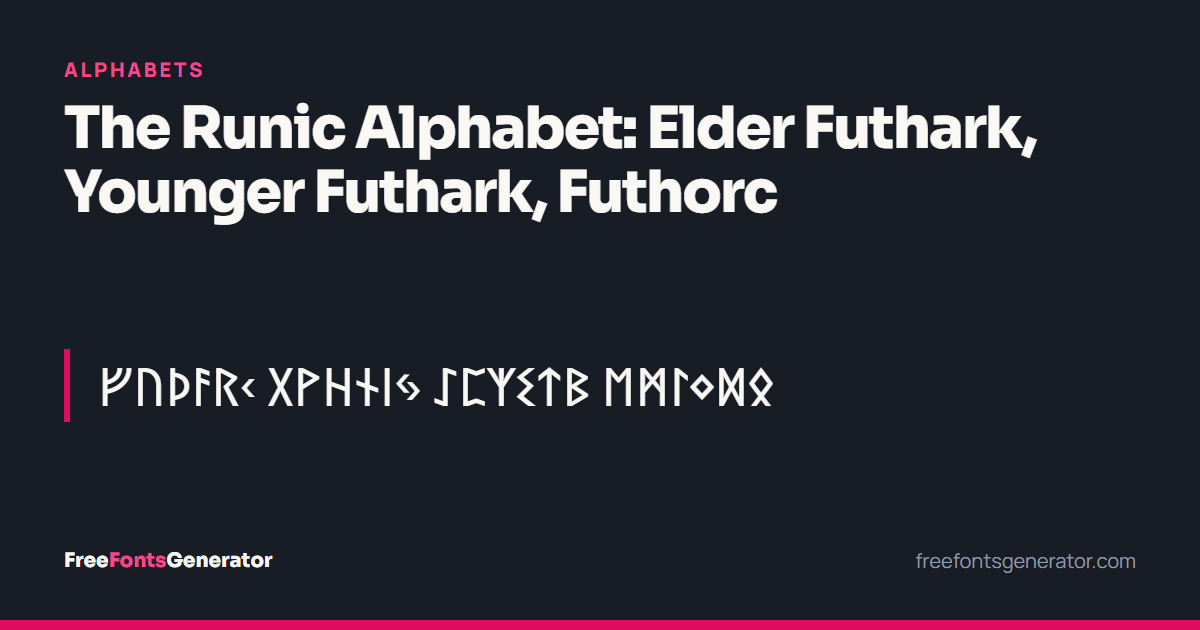
There is no single runic alphabet. There are several, used across a thousand years and a wide stretch of northern Europe, and they differ enough that a word written in one is not a word written in another. The three that matter — the ones nearly every search for “runic alphabet” is actually about — are the Elder Futhark, the Younger Futhark and the Anglo-Saxon futhorc.
All three are below, in full, with every rune’s name, sound and traditional meaning.
What the runic alphabet is
Runes are an alphabet, not a magic script and not a cipher. Germanic peoples wrote their own languages in them from roughly the 2nd century CE, and the shapes are angular because they were cut — into wood along the grain, into bone, into stone — where a curve is hard and a horizontal line disappears into the grain.
The name “futhark” is not a word. It is the first six runes read in order: ᚠ ᚢ ᚦ ᚨ ᚱ ᚲ — f, u, th, a, r, k — the same way “alphabet” is alpha and beta. Runic order has nothing to do with Latin order, which is one sign the script was not simply borrowed whole.
Each rune also carries a name, and the name is a word: ᚠ is fehu, “cattle”, which in a cattle economy means wealth. Those names are how the sounds were taught and remembered, and they are recorded in the rune poems — the Old English, Norwegian and Icelandic ones survive. The Wikipedia article on runes covers the manuscript sources.
Elder Futhark: the 24-rune alphabet
The oldest of the three, in use from about the 2nd to the 8th century across the Germanic-speaking world. Twenty-four runes, traditionally divided into three groups of eight called ættir.
| Rune | Name | Sound | Meaning |
|---|---|---|---|
| ᚠ | Fehu | f | cattle, wealth |
| ᚢ | Uruz | u | aurochs, strength |
| ᚦ | Thurisaz | th | giant, thorn |
| ᚨ | Ansuz | a | a god; mouth, speech |
| ᚱ | Raidho | r | ride, journey |
| ᚲ | Kenaz | k | torch |
| ᚷ | Gebo | g | gift |
| ᚹ | Wunjo | w | joy |
| ᚺ | Hagalaz | h | hail |
| ᚾ | Nauthiz | n | need, necessity |
| ᛁ | Isa | i | ice |
| ᛃ | Jera | j | year, harvest |
| ᛇ | Eihwaz | ei | yew tree |
| ᛈ | Perthro | p | uncertain; perhaps a dice cup |
| ᛉ | Algiz | z | elk; protection |
| ᛊ | Sowilo | s | sun |
| ᛏ | Tiwaz | t | the god Tyr |
| ᛒ | Berkano | b | birch |
| ᛖ | Ehwaz | e | horse |
| ᛗ | Mannaz | m | man, human |
| ᛚ | Laguz | l | water, lake |
| ᛜ | Ingwaz | ng | the god Ing |
| ᛞ | Dagaz | d | day |
| ᛟ | Othala | o | inherited land, heritage |
Note what is missing. There is no C, no Q, no V, no X and no Y, because the language being written did not need them. Any “runic alphabet A to Z” chart that gives you twenty-six neat equivalents has invented several of them.
Younger Futhark: the Viking Age runes
This is the one people mean by “Viking runes”. Between the 8th and 11th centuries the Scandinavian languages gained sounds while the alphabet lost runes, dropping from 24 to 16. The result is an alphabet with fewer letters than the language has sounds, so a single rune covers several — ᚴ writes k and g, ᛏ writes t and d.
| Rune | Name | Sound | Meaning |
|---|---|---|---|
| ᚠ | Fé | f | wealth |
| ᚢ | Úr | u | iron, or drizzle |
| ᚦ | Þurs | th | giant |
| ᚬ | Óss | o | a god, or river mouth |
| ᚱ | Reið | r | ride |
| ᚴ | Kaun | k | ulcer, sore |
| ᚼ | Hagall | h | hail |
| ᚾ | Nauðr | n | need |
| ᛁ | Ís | i | ice |
| ᛅ | Ár | a | plenty, good year |
| ᛋ | Sól | s | sun |
| ᛏ | Týr | t | the god Tyr |
| ᛒ | Bjarkan | b | birch |
| ᛘ | Maðr | m | man |
| ᛚ | Lögr | l | water |
| ᛦ | Ýr | R | yew |
This is the alphabet on the great majority of surviving runestones — there are several thousand in Sweden alone. It comes in two styles, long-branch (the formal one, shown here) and short-twig, a simplified cursive form for everyday carving.
If you are looking for genuinely Viking runes, this table is the one. The Elder Futhark had been out of use for two centuries before the Viking Age began.
Anglo-Saxon futhorc: the Old English runes
In England and Frisia the alphabet went the other way. Old English gained vowel sounds, so runes were added rather than removed, reaching 29 in common use and more in some inscriptions. The name changes too — futhorc rather than futhark, because the fourth rune’s sound shifted from a to o.
| Rune | Name | Sound | Meaning |
|---|---|---|---|
| ᚠ | Feoh | f | wealth |
| ᚢ | Ūr | u | aurochs |
| ᚦ | Þorn | th | thorn |
| ᚩ | Ōs | o | a god; mouth |
| ᚱ | Rād | r | ride |
| ᚳ | Cēn | c | torch |
| ᚷ | Gyfu | g | gift |
| ᚹ | Wynn | w | joy |
| ᚻ | Hægl | h | hail |
| ᚾ | Nȳd | n | need |
| ᛁ | Īs | i | ice |
| ᛄ | Gēr | j | year, harvest |
| ᛇ | Ēoh | eo | yew |
| ᛈ | Peorð | p | uncertain |
| ᛉ | Eolh | x | elk-sedge |
| ᛋ | Sigel | s | sun |
| ᛏ | Tīw | t | the god Tiw |
| ᛒ | Beorc | b | birch |
| ᛖ | Eh | e | horse |
| ᛗ | Mann | m | man |
| ᛚ | Lagu | l | water |
| ᛝ | Ing | ng | the hero Ing |
| ᛟ | Ēðel | oe | estate, homeland |
| ᛞ | Dæg | d | day |
| ᚪ | Āc | a | oak |
| ᚫ | Æsc | ae | ash tree |
| ᚣ | Ȳr | y | bow |
| ᛡ | Īor | io | eel, or beaver |
| ᛠ | Ēar | ea | grave, earth |
Two futhorc runes outlived the script entirely. Thorn (þ) and wynn (ƿ) were borrowed into the Latin alphabet to write Old and Middle English, because Latin had no letter for the th sound. Thorn is still a live letter in Icelandic today, and the “ye” in “Ye Olde Shoppe” is a misread thorn, never a Y.
Writing your name in runes
The Runic Unicode block
Every rune on this page is real text, because Unicode encodes them in a block called Runic, U+16A0 to U+16FF, added in Unicode 3.0. That block covers all three alphabets in one range, which is why the same character ᚠ serves as Fehu, Fé and Feoh.
Runic alphabet translator: what it has to decide
The rune translator converts your text into any of the three rows above and back again, in your browser. A few things it will tell you that a naive converter will not:
- Transliteration is by sound, not by letter. English th is one rune, ᚦ, not two. A c becomes ᚲ or ᚳ depending on the row.
- Some letters have no rune. The Elder Futhark has nothing for C, Q, V, X or Y. A conversion has to substitute or leave a gap, and it should tell you which it did.
- The three rows disagree. “Sarah” is ᛊᚨᚱᚨᚺ in Elder Futhark, ᛋᛅᚱᛅᚼ in Younger Futhark and ᛋᚪᚱᚪᚻ in futhorc. All three are correct; they are different alphabets.
- Historical runic used no spaces. Word dividers, when used at all, were a dot or a cross. Modern runic writing usually adds spaces so it can be read.
If this is for a tattoo, go through the tattoo lettering page as well and read the warnings there. A rune transliteration is a spelling decision, and it is worth having a second person who reads the script check it before anything is permanent.
What runes did not mean
Two things worth saying because the internet is full of the opposite.
Runic alphabet meanings, and where they come from
Runes were ordinary writing. Surviving inscriptions are largely mundane — maker’s marks, ownership labels, memorials, and in the Bergen finds, business notes and personal messages. They were used for charms too, as every script has been, but “runes were a magical alphabet” reverses the proportions.
The divination systems are modern. Rune-reading with fixed card-like meanings dates from the 20th century, chiefly from the work of Ralph Blum in the 1980s, and includes a “blank rune” that appears in no historical source. The traditional meanings in the tables above are the names of the runes as recorded in the rune poems — which is a different thing, and the only part with manuscript evidence behind it.
It is also worth knowing that a few runes, ᛉ and ᛊ in particular, were appropriated by the Nazi party and are still used by extremist groups. The runes themselves are two thousand years old and innocent; the context you put them in is not automatically so.
Quick answers
Which runic alphabet did the Vikings use?
The Younger Futhark, 16 runes. The Elder Futhark had fallen out of use before the Viking Age.
Is there a rune for every English letter?
No. None of the three alphabets maps cleanly onto A–Z; conversion goes by sound and some letters have no equivalent.
What does futhark mean?
Nothing — it is the first six runes read in order, f-u-th-a-r-k.
Can I type runes on a normal keyboard?
Not directly, but they are ordinary Unicode characters, so you can paste them anywhere. Whether they display depends on the fonts installed on the device reading them.
Why do some runes show as empty boxes?
Because that device has no font covering the Runic block. Why Unicode fonts break explains what is happening.
Where to go next
- Rune translator — all three rows, both directions
- Old English text generator — blackletter, which is a typeface, not runes
- Morse code alphabet — another alphabet shaped by its medium
- Unicode blocks reference — where the Runic block sits