The Morse Code Alphabet: Full A–Z Chart and How to Read It
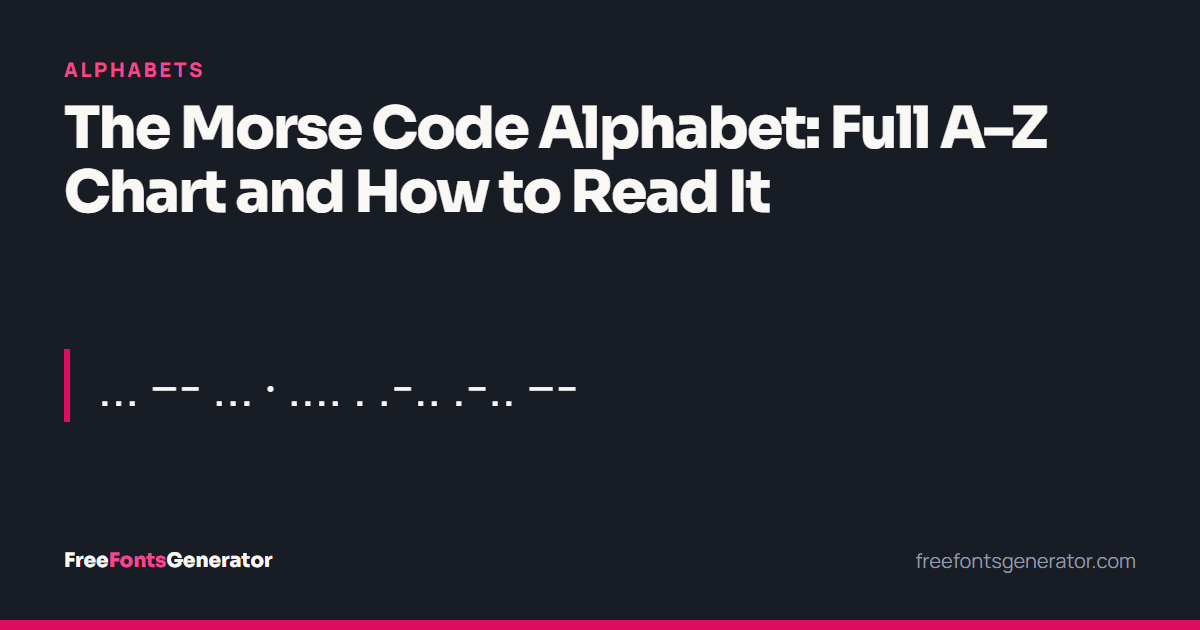
Morse code is not a font and not a cipher. It is a way of representing letters as durations — short and long — so they can travel down anything that can be switched on and off: a telegraph key, a lamp, a radio carrier, a finger tapping a table. That is why it has outlived every technology it was invented for.
Below is the full international Morse code alphabet, the numbers, the punctuation that is actually standardised, and the timing that makes the difference between readable code and noise.
The Morse code alphabet A to Z
A dot is short, a dash is three times as long. Read each row as one letter.
| Letter | Morse | Letter | Morse |
|---|---|---|---|
| A | .- | N | -. |
| B | -... | O | --- |
| C | -.-. | P | .--. |
| D | -.. | Q | --.- |
| E | . | R | .-. |
| F | ..-. | S | ... |
| G | --. | T | - |
| H | .... | U | ..- |
| I | .. | V | ...- |
| J | .--- | W | .-- |
| K | -.- | X | -..- |
| L | .-.. | Y | -.-- |
| M | -- | Z | --.. |
The lengths are not arbitrary. E is a single dot and T a single dash because they are the two most common letters in English; Q and Y are four symbols long because they are rare. Alfred Vail is generally credited with doing the counting, reportedly by weighing the type cases at a local newspaper to see which letters printers stocked most of.
Numbers 0 to 9
Every digit is exactly five symbols, which makes them easy to recognise inside a stream of letters.
| Digit | Morse | Digit | Morse |
|---|---|---|---|
| 1 | .---- | 6 | -.... |
| 2 | ..--- | 7 | --... |
| 3 | ...-- | 8 | ---.. |
| 4 | ....- | 9 | ----. |
| 5 | ..... | 0 | ----- |
The pattern is worth seeing once: 1 through 5 add dashes from the right, 6 through 0 take them away from the left.
Punctuation and prosigns
| Character | Morse | Character | Morse |
|---|---|---|---|
| Full stop | .-.-.- | Slash | -..-. |
| Comma | --..-- | Colon | ---... |
| Question mark | ..--.. | Semicolon | -.-.-. |
| Apostrophe | .----. | Equals | -...- |
| Exclamation | -.-.-- | Plus | .-.-. |
| Open bracket | -.--. | Hyphen | -....- |
| Close bracket | -.--.- | Underscore | ..--.- |
| Ampersand | .-... | Quotation | .-..-. |
| At sign | .--.-. | Dollar | ...-..- |
The at sign is the newest entry, added by the ITU in 2004 so email addresses could be sent — the first character added to Morse in more than half a century.
The timing rules that make it readable
This is what most charts leave out, and it is the reason a beginner’s Morse is unintelligible even when every letter is correct. Everything is measured in one unit, the length of a single dot:
| Element | Length |
|---|---|
| Dot (dit) | 1 unit |
| Dash (dah) | 3 units |
| Gap between symbols inside a letter | 1 unit |
| Gap between letters | 3 units |
| Gap between words | 7 units |
Get the gaps wrong and the letters run together: ...- is V, but ... - is S followed by T. Nothing about the dots and dashes distinguishes them — only the silence does. This is codified in ITU Recommendation M.1677-1, the international standard for Morse.
Experienced operators do not count units. They learn each letter as a rhythm — di-dah for A, dah-di-di-dit for B — which is the basis of the Koch and Farnsworth teaching methods still used by amateur radio clubs today.
SOS, and what it does not stand for
...---... is the international distress signal, sent as one continuous string with no letter gaps rather than as three separate letters. It was adopted at the 1906 Berlin radiotelegraphic conference for one reason only: it is unmistakable. Nine symbols, perfectly symmetrical, impossible to confuse with anything else through interference.
It is not an acronym. “Save Our Souls” and “Save Our Ship” were both invented afterwards as mnemonics. The Wikipedia article on SOS has the conference record.
Morse was formally retired from maritime distress duty in 1999, when the Global Maritime Distress and Safety System replaced it. It remains in daily use in amateur radio, in aviation navigation beacons, which identify themselves in Morse, and as an accessibility input method for people who can operate one switch.
Where Morse code lives in Unicode
Morse itself has no letters to encode — it is dots, dashes and silence, which is why it is nearly always written with the ordinary full stop and hyphen you have on your keyboard, exactly as in the tables above.
There is one exception. Unicode 16.0 added a Symbols for Legacy Computing Supplement containing dedicated Morse characters, but font support for them is almost nonexistent, so nothing practical uses them. If you are writing Morse anywhere it needs to be read — a message, a tattoo reference, a caption — use . and -.
Converting text to Morse code
The Morse code translator on this site converts in both directions and plays the result as audio at a speed you choose, which matters more than it sounds: Morse is a sound, and reading it off a page teaches you a different skill from hearing it. It runs entirely in your browser, so nothing you type is sent anywhere.
A few conventions worth knowing when you convert:
- Morse has no upper and lower case.
HelloandHELLOproduce identical code. - A forward slash
/is the usual way to write a word gap in text form. - There is no standard Morse for most accented letters, though a few languages added their own — ä, ö and ü have long-established codes in German practice.
American Morse and other variants
The code in the tables is International Morse, sometimes called Continental Morse. It is not the code Samuel Morse’s original telegraph used. American Morse had internal gaps inside some letters and dashes of two different lengths, which worked on a wire but fell apart over radio, where fading made length judgements unreliable. International Morse replaced it for radio work and eventually everywhere.
Several non-Latin scripts have their own Morse systems built on the same timing: Wabun code for Japanese kana, Cyrillic Morse for Russian, and Greek, Hebrew and Arabic variants. They share the dot-dash grammar and nothing else. Wikipedia’s Morse code article covers the family in detail.
Quick answers
How long does it take to learn?
Most people can recognise the full alphabet in a few weeks of short daily practice. Getting to conversational speed — 20 words a minute or more — takes months, and is done by ear, never by looking at a chart.
What speed is standard?
Speed is quoted in words per minute against the reference word PARIS, which is exactly 50 units long. Beginners work around 5 wpm; amateur radio contest operators run past 40.
Is Morse code still required for a radio licence?
No. The international requirement was dropped in 2003, and national regulators followed. It is now a skill people learn because they want to.
Can I tap Morse into a phone?
Yes. Both Android and iOS ship Morse input as an accessibility feature, so a single switch or two taps can drive an entire keyboard.
Where to go next
- Morse code translator — convert either direction, with audio
- NATO phonetic alphabet — the other alphabet built for bad signal
- Rune translator — a writing system rather than a signalling one
- All tools — everything on this site in one list